
Skip to content

Introducing Relational Performance

The Missing Metric.

Relational Performance and the Hidden Drivers of Organisational Success.

Most organisations are not short of data. They are short of understanding.

Traditional performance measures often reveal what has already happened. They rarely show the relational conditions quietly shaping risk, trust, decision quality and future value, before those outcomes appear in the numbers.

Mark Barnes · Founder, Relational Performance Institute
The problem

There are costs your financial statements cannot yet see.

Every organisation tracks revenue, margin, staff turnover, customer churn, safety incidents, productivity and operational results, but many of the conditions that influence those outcomes appear earlier, in relational patterns most organisations do not monitor well enough.

They appear when information stops travelling upward, trust deteriorates, teams avoid difficult conversations, customer confidence weakens, decisions are misunderstood, or people begin considering their future long before they resign.

By the time these signals appear in traditional measures, the commercial cost has often already begun.

The core principle

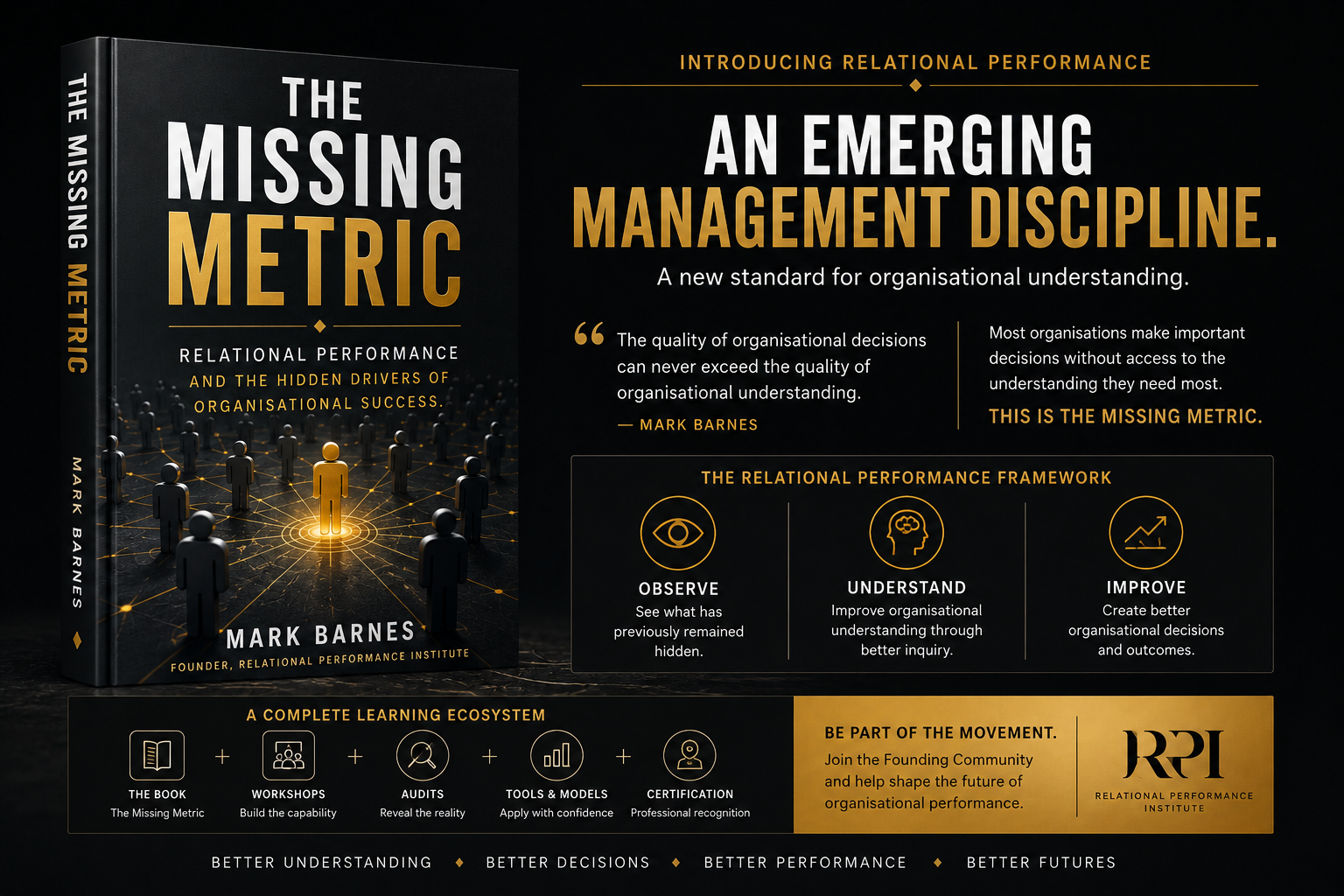
The quality of organisational decisions can never exceed the quality of organisational understanding.

Executives and boards make decisions under uncertainty every day. The problem is not usually that leaders do not care. It is that the information they need is often filtered, softened, delayed, distorted or left unsaid before it reaches them in a usable form.

Mark Barnes · The Missing Metric

Introducing Relational Performance

An emerging management discipline.

Learn About Relational Performance

Relational Performance is the phenomenon through which relational conditions influence organisational performance.

Relational conditions include trust, communication, alignment, inquiry safety, accountability, collaboration, conflict quality, leadership credibility, decision confidence and customer or supplier relationships.

These conditions are not soft. They are the conditions through which hard outcomes are produced.

Relational Performance does not tell leaders how to manage. It helps leaders see more clearly before they decide.

The book

About The Missing Metric.

The Missing Metric is the first major public translation of Relational Performance. It is written for leaders, executives, boards, advisors and decision-makers who want to understand what traditional measures often miss.

Why organisations often understand problems too late
How relational conditions shape commercial outcomes
Why feedback often fails to become organisational understanding
How recurring relational patterns become organisational signals
Why Relational Intelligence may provide earlier visibility of risk and opportunity
How leaders can decide better without replacing their own judgement
The Missing Metric — Relational Performance and the Hidden Drivers of Organisational Success. Book cover and the Relational Performance framework: Observe, Understand, Improve.

Inside the book

Three parts. One discipline.

Part I

The Blind Spot

  • The Orchestra — why organisations are not their people, leaders, systems or numbers in isolation.
  • The Cost of What Remains Unsaid — how known but uncommunicated organisational reality becomes commercial risk.
  • The Limits of Traditional Reporting — why traditional measures are necessary, but often late.
  • The Understanding Gap — why organisations decide based on what they understand, not what is true.

Part II

The Discipline

  • Introducing Relational Performance — the phenomenon through which relational conditions influence organisational performance.
  • Relational Conditions — the hidden operating conditions behind hard commercial outcomes.
  • Relational Intelligence — the organisational capability to understand relational conditions.
  • From Noise to Signal — how recurring relational patterns reveal emerging risk and opportunity.
  • Inquiry Without Blame — how organisations can learn the truth without weaponising feedback.

Part III

The Application

  • The Relational Performance Audit — a structured organisational inquiry into relational conditions.
  • The Commercial Cost of Insufficient Understanding — the costs traditional measures often reveal too late.
  • Leading Indicators of Future Performance — how Relational Intelligence may help organisations see earlier.
  • What Leaders Do With Better Understanding — why the discipline informs decisions without replacing them.
  • The Future of Organisational Understanding — why the next frontier is not more data, but better understanding.

A way of seeing

An organisation is not one musician.

An organisation is not the CEO, the manager, the frontline team, or the strategy, systems, budget and P&L. Like an orchestra, it is the performance that emerges from the interaction between all of them.

Traditional management often evaluates the musicians. Relational Performance seeks to understand the orchestra.

Keynote

How Relational Intelligence helps leaders see what traditional measures miss.

Designed for executive teams, boards, leadership conferences and organisations navigating complexity, growth or change.

Enquire About Speaking
Mark Barnes speaking on stage

Executive Briefing

A confidential conversation for CEOs, executives and boards.

A confidential discussion for senior leaders who want to understand whether Relational Performance may be relevant to their organisation. No pitch. No pressure.

Request a Briefing

Founding Practice Partner

Become a Founding Practice Partner.

The Relational Performance Institute is inviting a limited number of organisations to help shape the early application and refinement of Relational Performance. This is not beta testing. It is disciplined practice development.

Apply as a Founding Practice Partner

Help shape the discipline and build the evidence base

Founding Practice Partners receive early access to Relational Performance methodology, executive insight reporting and audit development.

Better understanding·Better decisions·Better futures

About Mark

Mark Barnes, founder of Relational Performance and author of The Missing Metric

Mark Barnes.

Mark Barnes is the founder of Relational Performance, author of The Missing Metric, and a strategic advisor, speaker and board contributor based in the Northern Territory.

His work has been shaped by more than 25 years across commercial operations, regional leadership, industrial supply, government engagement, community enterprise and board-level environments.

Mark developed Relational Performance after decades of observing how organisational outcomes are shaped not only by strategy, structure, finance and operations, but by the relational conditions through which people communicate, decide, collaborate, trust and perform.

Visit Mark Barnes Coaching & Advisory

See what traditional measures miss

Join the book waitlist.

Be first to know when The Missing Metric is available, plus early insights on Relational Performance as the book comes together.

No spam. Just the book, and the idea behind it.